
Refilling Our Underground Savings Account
Groundwater is a key resource under stress in California.
Communities rely on underground aquifers for drinking water, and farmers use groundwater as an essential water source, especially during times of drought. Many species and their habitats rely on the connection of groundwater to surface water to thrive. California’s recent drought has overdrawn these subterranean savings accounts, but we’re partnering with farmers, environmental advocates and the agricultural industry to pilot and scale a promising solution: groundwater recharge.
Recharging groundwater with available surface water in wet years can add up to big water savings that mean a more sustainable water future for farmers, communities and the environment.
The Problem
Water management “status quo,” which means a continued lack of funding as well as multiple storage options. When wet years do happen, we won’t be prepared, and we’ll lose significant water that benefits people, wildlife and agriculture.
The Potential
A reliable water supply means rural economies thrive and California keeps leading as an agriculture and environmental powerhouse.
- Yale Environment 360
Where Water is Scarce, Communities Turn to Reusing Wastewater - Los Angeles Times
One key way soggy California could save water - ABC 30-TV
Fresno county grower sees big opportunity in all the excess rain - CNBC
Flooding the Farms - Fresno Bee
Flood Valley fields: Farmer incentives would pump up aquifer recharge - Water Deeply.org
Why California Can’t go Back to ‘Normal’ After Drought
- Almond Board of California
- Bachand & Associates
- California Department of Food and Agriculture
- California Roundtable on Water and Food Supply
- California Water Action Collaborative
- California Department of Water Resources
- Earth Genome
- Efird Ag Enterprises
- General Mills
- Kings River Conservation District
- Laguna Irrigation District
- LandIQ
- Lawrence Berkeley National Laboratory
- Ludhorff and Scalmanini, Consulting Engineers
- Madera Irrigation District
- Nick Blom Ranch
- Prado Farms LLC
- Public Policy Institute of California
- RMC Water and Environment
- Sequoia Riverlands Trust
- Stanford Center for Groundwater Evaluation and Management
- Terranova Ranch
- Tetra Tech Research and Development
- Tulare Irrigation District
- University of California, Davis
- Water Foundation
- SGMA system mapping – identifying the relationships between people, entities and actions related to SGMA implementation.
- Groundwater Recharge Assessment Tool – which helps irrigation districts, water managers and farmers prioritize the most cost-effective groundwater recharge projects throughout California.
In an average year, groundwater makes up about 30% of the total water used to irrigate California’s crops. During California’s last drought, that total doubled to 60%. This was especially true for those farming in the drier, southern part of California’s vast Central Valley – the nation’s most productive agricultural region.
Recharging Depleted Groundwater Supplies in the Central Valley
California is facing an increasingly changing climate. Dry and wet years are expected to get more frequent and extreme, and we need to think about multiple options to capture and save as much water as possible when it’s available to bolster our communities, agriculture and climate resiliency for the future. Groundwater supplies sustain communities, farms and the environment in times of drought, but they’re in trouble – over-pumping during dry times leads to land subsidence, shallow wells going dry, and poor water quality.
Groundwater aquifers have more than three times the capacity of our currently available surface storage, and are a key part of the puzzle for a sustainable water future in California. We need to find collaborative and innovative ways to ensure our aquifers are replenished so people and the environment have the water they need to weather future dry years.
Putting Water Back into the Bank
Our recent drought and first-of-its-kind groundwater legislation that will bring declining aquifers back into balance mean we have a significant opportunity to change the way water management works in California.
Sustainable Conservation is working with farmers, researchers, industry groups, environmental advocates and legislators to pilot on-farm groundwater recharge across the Central Valley. Farms use existing irrigation canals to deliver water that would otherwise flow out to the ocean or potentially imperil downstream communities to active and fallow fields, allowing it to spread out and percolate down to refill the aquifers underground.
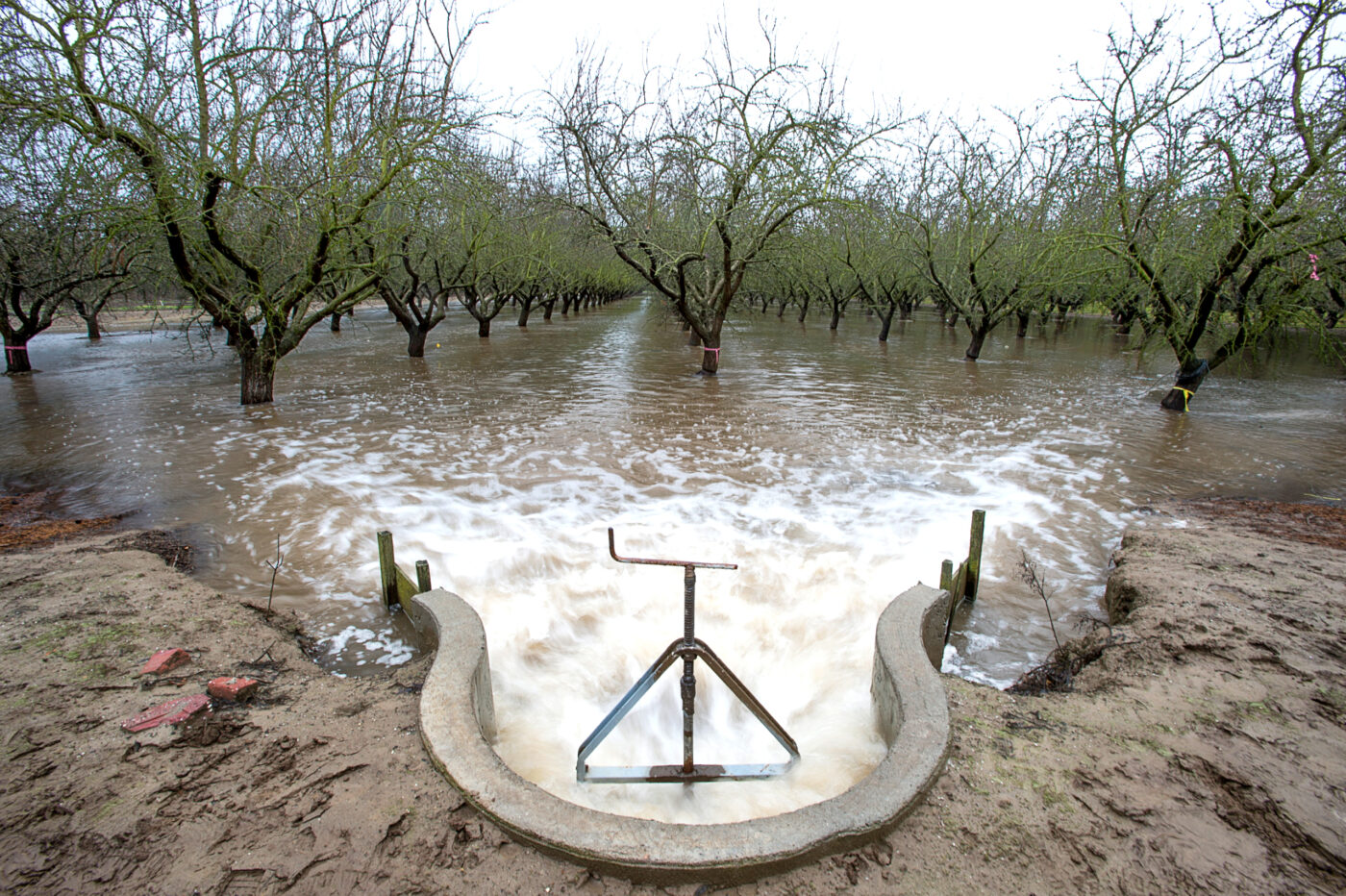
Together with our partners, we’re working with every level of water user to help California manage groundwater more sustainably by:
- Demonstrating and fine-tuning on-farm recharge on widely-grown crops like almonds, walnuts and wine grapes with innovative farmers and analyzing the results so more growers have the tools and knowledge to try the practice and be part of the solution;
- Evaluating incentives for farmers who recharge groundwater to be compensated and rewarded for replenishing local water supplies we all depend on;
- Building and scaling a first-of-its-kind platform, the Groundwater Recharge Assessment Tool (GRAT), with irrigation districts to maximize groundwater recharge in critical regions, and;
- Coordinating with policymakers, government and industry groups to make sure leaders across the state communicate and understand groundwater recharge’s potential as a key drought solution.
Groundwater recharge replenishes aquifers, eases flood hazards for downstream residents, and boosts a sustainable water supply for local communities and agriculture, so we can know for certain that California’s water is secure and safe for future generations.
Related news
May 11 2023
Introducing Eric Epstein & Sam Williams
Meet our two newest interns! Lorem ipsum dolor sit amet, consectetur adipiscing elit.
April 16 2023
Publications Round-Up: PPIC Policy Brief and EDF Land Repurposing Guide
A Latin professor at Hampden-Sydney College in Virginia, looked up one of the more obscure Latin words, consectetur, from a Lorem Ipsum passage, and discovered the undoubtable source.
March 30 2023
Restoration Gets a Legislative Boost: Habitat and Restoration Enhancement Act Renewed!
Contrary to popular belief, Lorem Ipsum is not simply random text.
April 28 2023
California Cuts the Green Tape
We’re making it easier for landowners of all kinds to restore rivers, streams, and other habitats on their land.